


American breakfast cereals exist as a culinary innovation which represents American food production after World War II and the development of American food branding. To analyse why cereal rules American mornings, one should consider American breakfast culture, where notions of convenience, bulk production, and advertising collide
Breakfast cereals have transformed American breakfast customs through their evolution from health reform societies to the introduction of cartoon mascots.
A brief history of breakfast cereals in the USA
Breakfast cereals are actually a late-19th-century invention, historically promoted by health reformers who advocated grain-based diets. The activity was closely tied to the sanitariums and dietary reform advocates such as John Harvey Kellogg, whose work ultimately stimulated the commercial production of cereals. Cereal became a common food after World War II when:
- The modern packaged food
- Suburban households demanded speed and convenience
- National advertising by food companies took off
The Smithsonian Institution describes how postwar industrialisation altered eating practices in America, and that included breakfast.
Corn Flakes

Corn Flakes were among the earliest cereals to reach bulk adoption in the United States
Why corn flakes matter:
- The company has developed a product for the ready-to-eat market.
- It has marked the ascent of large-scale food branding.
- It became a breakfast staple in early industrial America
Corn Flakes have been important in the success of the idea of American breakfast foods, so dear to us now.
Cheerios

Cheerios was founded in 1941, and Cheerios reflected wartime production efficiency and nutritional messaging
Cultural significance:
- Made an advertisement for oats as a heart-healthy grain
- Earned the trust of several generations
- Remained historically resonant through slight modifications in ingredients
The accomplishment story of Cheerios shows on more themes of American food, where practicality and health slowly became part of daily consumption
Frosted Flakes
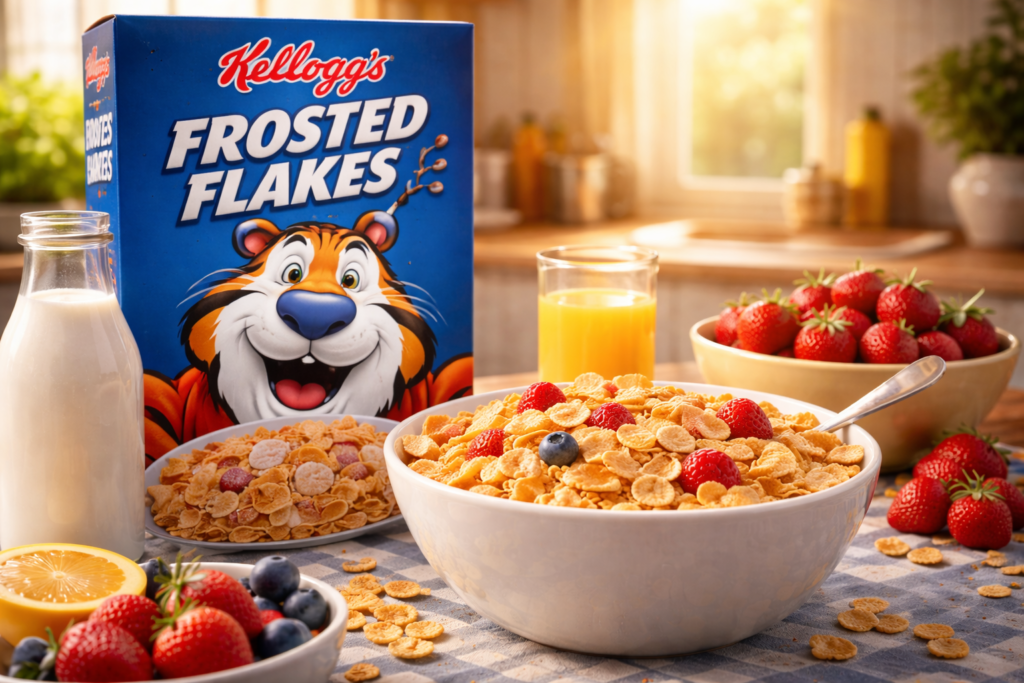
Founded around the 1950s, Frosted Flakes showcased a critical point in cereal history
Why frosted flakes became renowned :
- Introduced sugar-forward flavours to breakfast
- Leveraged television advertising and mascots
- Targeted children during the rise of TV culture
This shift displayed the boom of consumer marketing in post-war America.
Lucky Charms

Lucky Charms was introduced in 1964 during the glory period of television advertising
What made it revolutionary:
- Merging different cereals with marshmallows into one
- Creating an Identity Driven by Make-Believe Branding
- Connecting Breakfast with Entertainment and Tales
Raisin Bran

Raisin Bran carved a distinct identity as a fibre-rich alternative
Why it endured:
- Adult consumers appealed to
- Maintained significance amid syrupy competitors
- Its success showcases the longstanding rigidity between indulgence and health consciousness in the American diet
Post-war breakfast culture and the increase of cereals
Emphasising fast, cheap, and appealing to children, families began to perceive breakfast foods differently after the Second World War. The Library of Congress documents how processed foods became a symbol of post-war prosperity and domestic efficiency. During this period, breakfast cereals were marketed as an essential contribution to productivity, school performance, and family routine
Brand growth: From pantry staple to cultural icon
With the passage of time, cereal brands have evolved through the following:
- Expansion of flavours
- Changes to nutrition messaging
- Renewing the package and mascots
Despite the competition from modern organic and protein-driven cereals, vintage ones still prevail over the market, mainly due to some nostalgia and cultural presence
Why these cereals still matter today

The cereals are not simply well-selling products; they are also indicators of how Americans:
- Consume food
- React to marketing
- Formulate daily rituals
They are at the crossover of food, culture, and commerce in the United States
Conclusion
The best American breakfast cereals last because they evolve but do not conform. From the unmixed Corn Flakes to the fanciful Lucky Charms, cereals encompass a wide narrative about American innovation, convenience, and branding.
For anyone who goes into the history of food in the United States or cuisine from the U.S., cereal provides some of the most accessible insights into the day-to-day life of Americans.